


Índice de integridad del suelo en un muro de contención con gaviones
Article Sidebar
Main Article Content
 http://orcid.org/0009-0006-3136-4861
Jesús Emmanuel Cerón-Carballo
http://orcid.org/0000-0003-2809-3387
Humberto Iván Navarro-Gómez
http://orcid.org/0000-0003-2338-4863
Resumen
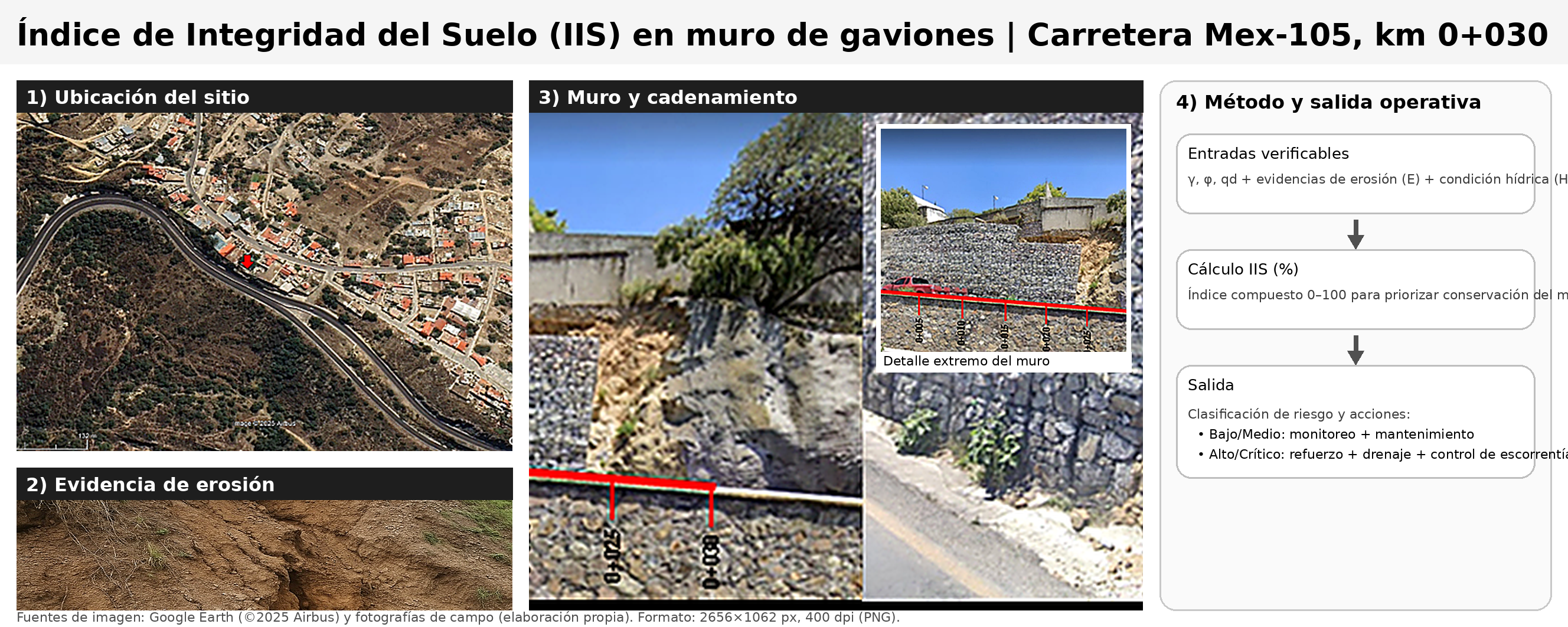
Este estudio evalúa la estabilidad de un muro de contención con gaviones ubicado en la Carretera Federal México 105, en el estado de Hidalgo, tramo clave del corredor México–Pachuca–Tampico. El objetivo fue determinar la condición actual del muro y estimar un Índice de Integridad del Suelo (IIS) como indicador del grado de compactación, cohesión y resistencia frente a procesos erosivos. La metodología integró levantamientos topográficos, inspección visual y fotográfica, así como exploraciones geotécnicas en cinco estaciones (profundidades de 4–8 m). Se obtuvieron valores de densidad natural (1 480–1 620 kg/m³), ángulo de fricción interna (26°–30°) y capacidad de carga admisible (7–12 kg/cm²). Estos parámetros se incorporaron al cálculo del IIS junto con un factor de erosión. Los resultados muestran que el tramo inicial (0+000 a 0+020) conserva estabilidad estructural adecuada, mientras que en el cadenamiento 0+030 se detectó erosión activa, pérdida de compactación y reducción del IIS hasta un 85% respecto a la condición de referencia (2015 = 100%). Se concluye que la falta de extensión del muro en dicho punto genera un riesgo crítico, recomendándose ampliar la estructura, reforzar el drenaje y aplicar técnicas de estabilización y revegetación. El IIS se plantea como herramienta práctica para monitorear la integridad de taludes carreteros.
##plugins.generic.usageStats.downloads##
Article Details

Esta obra está bajo licencia internacional Creative Commons Reconocimiento-NoComercial-SinObrasDerivadas 4.0.
Citas
[2] R. Chairullah et al., “The investigation of stability on slopes utilizing reinforcement gabion walls and concrete piles for mitigating landslide disasters,” Open Civil Engineering Journal, 2024.
[3] M. T. T. Cho, A. Chueasamat, T. Hori, H. Saito, and Y. Kohgo, “Effectiveness of filter gabions against slope failure due to heavy rainfall,” Soils and Foundations, vol. 61, no. 2, pp. 544–556, 2021.
[4] S. Laudari, T. Hara, and H. Nakazawa, “Stability analysis of low-cost gabion revetments for adoption in developing countries: Insights from field investigations and laboratory experiments,” Journal of Civil Engineering and Architecture, vol. 18, no. 12, pp. 565–580, 2024.
[5] M. Wang and L. Li, “Slope stability analysis considering degradation of soil properties induced by intermittent rainfall,” Water, vol. 17, no. 6, p. 814, 2025.
[6] U.S. Department of Transportation, Federal Highway Administration (FHWA), “Geotechnical site characterization” Geotechnical Engineering Circular (GEC) No. 5, FHWA-NHI-16-072, 2017. [Online]. Available: https://rosap.ntl.bts.gov/view/dot/40558
[7] B. B. Mijic, M. K. Mijic, M. S. Maksimovic, and M. D. Petrovic, “Estimation of maximum and minimum densities of granular soils from grading curves,” Soils and Foundations, vol. 61, no. 1, pp.158–175, 2021.
[8] J. E. Cerón-Carballo, E. Pérez-Isidro, and H. I. Navarro-Gómez, “Análisis de riesgo en puente peatonal tipo armadura utilizando sensores,” Pädi Boletín Científico de Ciencias Básicas e Ingenierías del ICBI, vol. 9, no. 18, pp. 40–46, 2022.
[9] C. Liu, A. Q. Huang, and P. J. Huang, “Field assessment of soil strength based on shear wave velocity,” Soils and Foundations, vol. 61, no. 1, pp. 176–186, 2021.
[10] A. Uray and Z. W. Geem, “Metaheuristic approaches for gabion wall stability optimization,” Mathematics, vol. 13, no. 19, p. 3216, 2025.
[11] X. Liu, X. Zhang, L. Kong, X. Li, and G. Wang, “Effect of cementation on the small-strain stiffness of granite residual soil,” Soils and Foundations, vol. 61, no. 2, pp. 520–532, 2021.
[12] R. Hinsberger, “Analysis of heavy precipitation-induced rill erosion,” Environmental Earth Sciences, vol. 83, no. 11, p. 354, 2024.
[13] X. Wu, X. Liu, Y. Qiao, and J. Sun, “Effects of rock fragments on the water infiltration and hydraulic conductivity in the soils of the desert steppes of inner mongolia, china,” Soil and Water Research, vol. 16, no. 1, pp. 26–34, 2021.
[14] T. A. T. Doan, Q. D. Ma, and V. K. Pham, “Study on internal friction angle affected by different groundwater content using finite element method,” Journal of Applied Engineering Science, vol. 21, no. 4, pp. 1056–1067, 2023.
[15] S. D. Chikute and R. M. Sonar, “Failures of gabion walls and its remedies,” in Innovations in Infrastructure, ser. Lecture Notes in Civil Engineering. Springer, 2022.
[16] Y. Ma, Y. Wang, Y. Zhang, R. Zhang, C. Yuan, C. Ma, and Y. Bai, “Effects of gravel on the water infiltration process and hydraulic parameters of stony soil in the eastern foothills of helan mountain, china,” Scientific Reports, vol. 14, p. 16426, 2024.
[17] Queensland Department of Transport and Main Roads, “Drafting and design presentation standards,” 2021, available: https://www.tmr.qld.gov.au/business-industry/Technical-standardspublications/Drafting-and-design-presentation-standards.
[18] ASTM International, “Standard test methods for laboratory determination of density and unit weight of soil specimens (astm d7263-21); standard test method for direct shear test of soils under consolidated drained conditions (astm d3080/d3080m-23); standard test method for standard penetration test (spt) and split-barrel sampling of soils (astm d1586/d1586m-18e01),” 2023.
[19] M. Niromand, A. Derakhshan, M. K. Asadi, and J. P. Frattini, “Dynamic modeling approach for assessing the stability of closed dump slopes,” Journal of Mining and Environment, 2024.
[20] H. Zhang, G. Guo, H. Li et al., “Un nuevo método numérico para calcular la deformación residual en zonas minadas considerando la interacción agua-roca y su aplicación,” Scientific Reports, vol. 15, p. 11207, 2025.
[21] S. Kumar et al., “The effect of slope height and angle on the safety factor and modes of failure of 3d slopes analysis using limit equilibrium method,” Innovative Infrastructure Solutions, vol. 8, 2023.
[22] L. Brocca et al., “What if rain falls? insights from a wide ensemble of drought scenarios,” in Climate Change Impacts on Water Resources: Developing Adaptation Strategies. Atlantis Press, 2023.
[23] T. Puértolas and I. C. Dodd, “Nocturnal transpiration and soil evaporation both decrease with increasing root length density,” Plant and Soil, vol. 475, pp. 377–390, 2022.
[24] K. Mukunoki, T. Yamakawa, T. Sato, and A. Shimizu, “A simple method for estimating density of sandy soils from shear wave velocity,” Soils and Foundations, vol. 61, no. 2, pp. 557–572, 2021.
[25] S. Zhao et al., “Slope unit-based landslide susceptibility mapping using machine learning models,” Frontiers in Earth Science, p. Art. 589630, 2021.
[26] D. G. Fredlund, N. R. Morgenstern, and R. A. Widger, “The shear strength of unsaturated soils,” Canadian Geotechnical Journal, vol. 15, no. 3, pp. 313–321, 1978.
[27] S. K. Vanapalli, D. G. Fredlund, D. E. Pufahl, and A. W. Clifton, “Model for the prediction of shear strength with respect to soil suction,” Canadian Geotechnical Journal, vol. 33, no. 3, pp. 379–392, 1996.
[28] A. Bhardwaj, A. Bhardwaj, M. Sarda, and N. Bichewar, “Stability analysis and construction of highest gabion wall of its own kind in india-a case study,” Journal of Mining and Environment, vol. 15, no. 1, pp. 191–202, 2024