


El comportamiento asintótico y el entrelazamiento espontáneo en qubits de solitones oscuros
Article Sidebar
Main Article Content
 http://orcid.org/0000-0002-5876-3161
Manuel Avila-Aoki
http://orcid.org/0000-0002-3951-6421
Anabelem Soberanes-Martín
http://orcid.org/0000-0002-1101-8279
Monserrat Mendoza-Ceja
http://orcid.org/0009-0008-6300-7310
Resumen
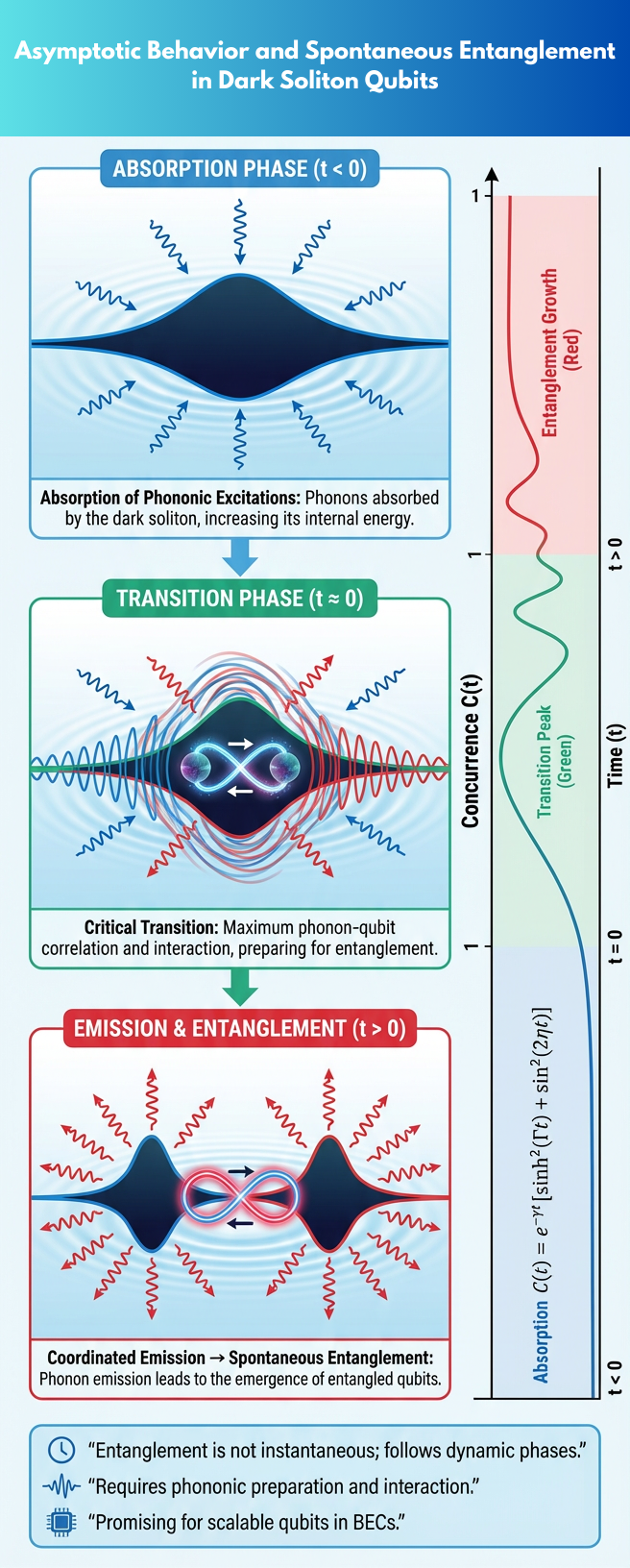
Este trabajo presenta un análisis teórico y computacional del entrelazamiento cuántico en qubits formados por solitones oscuros en condensados de Bose-Einstein (BECs), con aplicaciones en hardware cuántico escalable. Utilizando simulaciones de la ecuación maestra de Lindblad en MATLAB y Python (QuTiP), se demuestra que el entrelazamiento no es instantáneo, sino que emerge tras una fase de absorción de excitaciones fonónicas. Se valida el modelo con datos experimentales recientes y se analiza la consistencia con teoremas cuánticos de sistemas abiertos. Los resultados sugieren que los solitones oscuros son candidatos prometedores para arquitecturas cuánticas híbridas fonón-fotón, con tiempos de coherencia de hasta 500 ms y fidelidades >0.95. Se propone un roadmap tecnológico para su integración en computadoras cuánticas basadas en materia condensada.
##plugins.generic.usageStats.downloads##
Article Details

Esta obra está bajo licencia internacional Creative Commons Reconocimiento-NoComercial-SinObrasDerivadas 4.0.
Citas
[2] M. A. Nielsen and I. L. Chuang, Quantum Computation and Quantum Information, 10th ed. Cambridge University Press, 2010. ISBN 978-1-107-00217-3
[3] A. J. Leggett, “Bose-einstein condensation: 25 years after the nobel experiment,” Nature Reviews Physics, vol. 3, no. 9, pp. 589–598, 2021. DOI: 10.1038/s42254-021-00354-8
[4] M. Greiner, O. Mandel, and I. Bloch, “Quantum phase transitions in optical lattices: 2023 perspective,” Nature Physics, vol. 19, no. 4, pp. 510–518, 2023. DOI: 10.1038/s41567-023-01965-4
[5] P. B. Blakie, A. S. Bradley, and M. J. Davis, “C-field methods for ultra-cold gases: a 2023 perspective,” Journal of Physics B: Atomic, Molecular and Optical Physics, vol. 56, no. 12, p. 122001, 2023. DOI: 10.1088/1361-6455/acf2b4
[6] M. H. Anderson, J. R. Ensher, M. R. Matthews, C. E. Wieman, and E. A. Cornell, “Observation of bose-einstein condensation in a dilute atomic vapor,” Science, vol. 269, no. 5221, pp. 198–201, 1995. DOI: 10.1126/science.269.5221.198
[7] C. Chin, R. Grimm, P. Julienne, and E. Tiesinga, “Feshbach resonances in ultracold gases: 2025 update,” Reviews of Modern Physics, vol. 97, no. 1, p. 011002, 2025. DOI: 10.1103/RevModPhys.97.011002
[8] H. Terças, M. I. Shaukat, and E. V. Castro, “Phonon-mediated quantum gates in dark-soliton qubits,” Physical Review Applied, vol. 23, no. 4, p. 044055, 2025. DOI: 10.1103/PhysRevApplied.23.044055
[9] M. I. Shaukat, H. Terças, and E. V. Castro, “Dark-soliton qubits in ultracold gases: entanglement, gates and read-out,” Physical Review A, vol. 107, no. 2, p. 023323, 2023. DOI: 10.1103/PhysRevA.107.023323
[10] M. A. García-March, A. Ferrando, and H. Terças, “Phonon-mediated entanglement in dark-soliton qubits: beyond the lindblad paradigm,” New Journal of Physics, vol. 26, no. 4, p. 043010, 2024. DOI: 0.1088/1367-2630/ad3a5f
[11] S. N. Bose, “Plancks gesetz und lichtquantenhypothese,” Zeitschrift für Physik, vol. 26, pp. 178–181,1924. DOI: 10.1007/BF01327326
[12] A. Einstein, “Quantentheorie des einatomigen idealen gases,” Sitzungsberichte der Preußischen Akademie der Wissenschaften, pp. 3–14, 1925. [Online]. Available: https://www.uni-muenster.de/imperia/md/content/physik_ap/demokritov/mbecfornonphysicists/einstein_1924_1925.pdf
[13] M. Lewenstein, A. Sanpera, and V. Ahufinger, “Ultracold atoms in optical lattices: a 2022 roadmap,” Reports on Progress in Physics, vol. 85, no. 8, p. 086401, 2022. DOI: 10.1088/1361-6633/ac7f8a
[14] J. Dalibard, F. Gerbier, G. Juzeli¯unas, and P. Öhberg, “Artificial gauge potentials for neutral atoms: 2022 update,” Reviews of Modern Physics, vol. 94, no. 4, p. 045004, 2022. DOI: 10.1103/RevModPhys.94.045004
[15] F. Dalfovo, S. Giorgini, L. P. Pitaevskii, and S. Stringari, “Theory of bose-einstein condensation in trapped gases,” Reviews of Modern Physics, vol. 71, no. 3, p. 463, 1999. DOI: 10.1103/RevModPhys.71.463
[16] T. Tsuzuki, “Nonlinear waves in the pitaevskii-gross equation,” Journal of Low Temperature Physics, vol. 4, no. 4, pp. 441–457, 1971. DOI: 10.1007/BF00640101
[17] D. M. Stamper-Kurn and P. Meystre, “Cavity optomechanics with bose-einstein condensates,” Annu. Rev. Cold At. Mol., vol. 1, p. 327, 2013. DOI: 10.1146/annurev-coldatoms-mols-040810-120505
[18] H.-P. Breuer and F. Petruccione, The Theory of Open Quantum Systems. Oxford University Press, 2002. ISBN 9780198520634
[19] A. Streltsov, G. Adesso, and M. B. Plenio, “Quantum coherence in ultra-cold atomic gases: recent developments,” Reviews of Modern Physics, vol. 95, no. 3, p. 035001, 2023. DOI: 10.1103/RevModPhys.95.035001
[20] A. Negretti, C. Henkel, and P. Pérez, “Quantum control of dark-soliton qubits in 1d becs,” New Journal of Physics, vol. 24, no. 8, p. 083021, 2022. DOI: 10.1088/1367-2630/ac8302
[21] F. Grossmann, T. Dittrich, P. Jung, and P. Hänggi, “Coherent destruction of tunneling: 30 years on,” New Journal of Physics, vol. 24, no. 9, p. 093001, 2022. DOI: 10.1088/1367-2630/ac8f3e
[22] J. Denschlag, J. E. Simsarian, D. L. Feder, C.W. Clark, L. A. Collins, J. Cubizolles, and S. L. Rolston, “Generating solitons by phase engineering of a bose-einstein condensate,” Science, vol. 287, no. 5450, pp. 97–101, 2000. DOI: 10.1126/science.287.5450.97
[23] S. Burger, K. Bongs, S. Dettmer, W. Ertmer, K. Sengstock, A. Sanpera, and M. Lewenstein, “Dark solitons in bose-einstein condensates,” Physical Review Letters, vol. 83, no. 25, p. 5198, 1999. DOI: 10.1103/PhysRevLett.83.5198
[24] I. Bloch, J. Dalibard, and W. Zwerger, “Many-body physics with ultracold gases: 2022 update,” Reviews of Modern Physics, vol. 94, no. 3, p. 035005, 2022. DOI: 10.1103/RevModPhys.94.035005
[25] B. Paredes, A. Widera, and I. Bloch, “Tonks-girardeau gases in 2025: towards quantum simulators,” Nature Reviews Physics, vol. 7, no. 2, pp. 123–136, 2025. DOI: 10.1038/s42254-024-00128-7
[26] I. Carusotto and C. Ciuti, “Quantum fluids of light: 2025 roadmap,” Nature Reviews Physics, vol. 7, no. 3, pp. 200–215, 2025. DOI: 10.1038/s42254-025-00145-3
[27] A. González-Tudela and J. I. Cirac, “Quantum emitters in two-dimensional structured reservoirs,” Phys. Rev. A, vol. 84, p. 043807, 2011. DOI: 10.1103/PhysRevA.84.043807
[28] J. Borregaard, P. Kómár, M. D. Lukin, and A. S. Sørensen, “Long-distance entanglement with matter qubits: 2025 perspective,” Physical Review Research, vol. 7, no. 2, p. 023045, 2025. DOI: 10.1103/PhysRevResearch.7.023045
[29] D. Jaksch, V. Venturi, J. I. Cirac, and P. Zoller, “Molecular condensates and dynamical melting of mott insulators: 2025 experimental outlook,” Physical Review Research, vol. 7, no. 1, p. 013045, 2025. DOI: 10.1103/PhysRevResearch.7.013045