


Enfoque Experimental Óptico para la Emulación del Comportamiento Direccional del Beamforming de Radiofrecuencia para el Estudio de la Captación Inalámbrica de Energía
Article Sidebar
Main Article Content
 http://orcid.org/0009-0006-2802-1171
Carlos Mauricio Castorena
http://orcid.org/0000-0002-4202-1008
Juan Antonio De Rus
http://orcid.org/0000-0001-8982-2518
Sandra Roger
http://orcid.org/0000-0003-4808-252X
Carmen Botella-Mascarell
http://orcid.org/0000-0002-9296-5576
Resumen
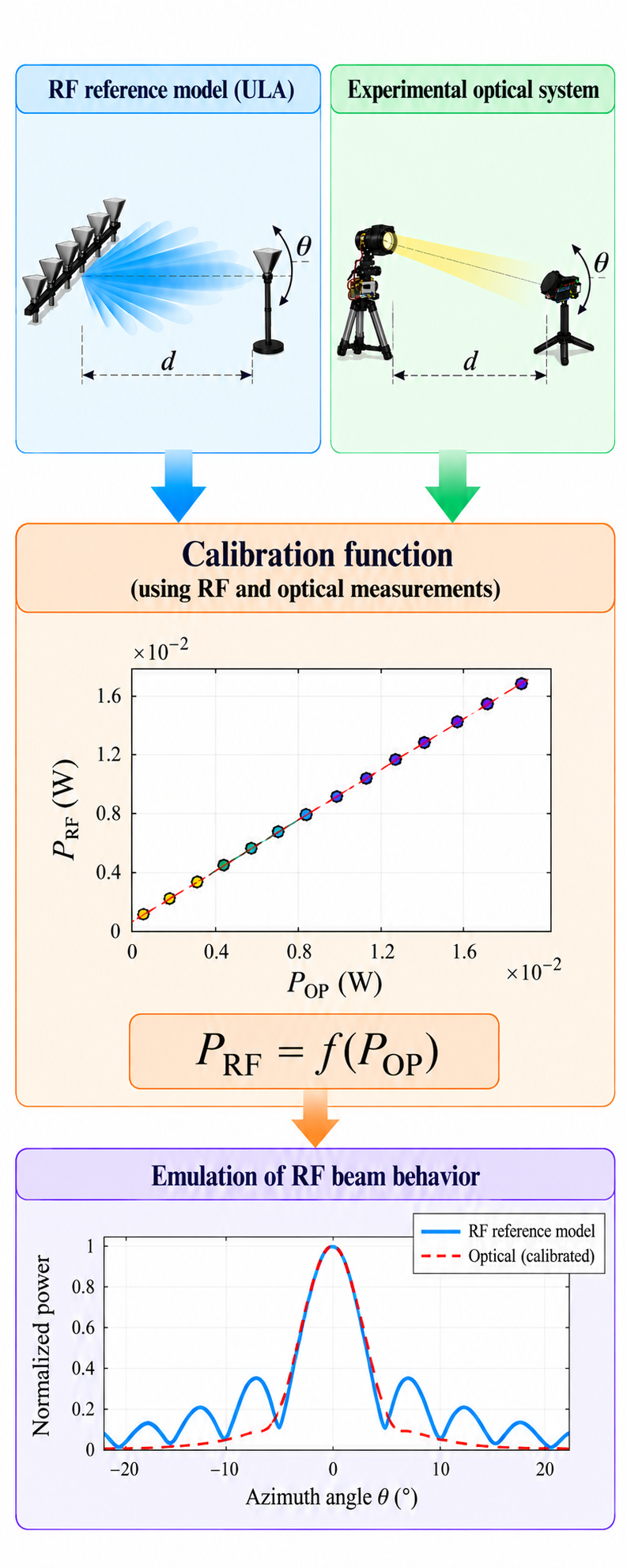
La generación de haces de radiofrecuencia mediante beamforming permite dirigir la potencia transmitida hacia determinadas regiones del espacio, lo que resulta de interés en aplicaciones de captación inalámbrica de energía y gestión de la energía disponible en dispositivos. En estos sistemas, conocer cómo varía la potencia recibida según la posición y orientación del receptor es relevante para estudiar las condiciones de disponibilidad energética y las decisiones asociadas a su administración. Aunque este comportamiento puede analizarse mediante modelos matemáticos y simulaciones numéricas, su estudio experimental mediante sistemas de radiofrecuencia requiere hardware específico para generar, controlar y medir los haces, lo que puede resultar costoso cuando se necesitan múltiples condiciones de operación. En este trabajo se propone un enfoque experimental óptico para emular la potencia de radiofrecuencia que estaría disponible en diferentes posiciones y orientaciones respecto a un haz generado mediante beamforming. El sistema utiliza una fuente luminosa para generar un haz dirigido y un receptor óptico para registrar su distribución angular. La propuesta no busca reproducir la transferencia de energía ni la física electromagnética del haz de radiofrecuencia, sino proporcionar una representación experimental de su potencia recibida equivalente. Para ello, las lecturas del receptor óptico se relacionan mediante una función empírica con la potencia proporcionada por un modelo matemático de radiofrecuencia. El enfoque se evalúa comparando la amplitud, posición angular y ancho angular de las distribuciones óptica y de radiofrecuencia. Los resultados muestran que el sistema óptico puede emular la potencia recibida equivalente y conservar la distribución angular bajo las condiciones evaluadas.
##plugins.generic.usageStats.downloads##
Article Details

Esta obra está bajo licencia internacional Creative Commons Reconocimiento-NoComercial-SinObrasDerivadas 4.0.
Citas
[2] G. K. J. Fischer, T. Schaechtle, A. Gabbrielli, J. Bordoy, I. Häring, F. Höflinger, and S. J. Rupitsch, “A systematic survey and comparative analysis of angular-based indoor localization and positioning technologies,” IEEE Communications Surveys & Tutorials, vol. 28, pp. 3830–3869, 2026. DOI: 10.1109/COMST.2025.3567765
[3] M. Kaczy´nski, Z. Piotrowski, and D. Pietrow, “A survey of machine learning techniques for signal source localization and emitter tracking,” IEEE Access, vol. 13, pp. 198 390–198 409, 2025. DOI: 10.1109/ACCESS.2025.3629818
[4] W. Ma, L. Zhu, Y. Tan, B. Zheng, Y. Zhang, Y. Zhang, K. Ying, Z. Gao, H. Sun, X. Shao, Z. Xiao, D. Niyato, and R. Zhang, “A survey on reconfigurable and movable antennas for wireless communications and sensing,” IEEE Communications Surveys & Tutorials, vol. 28, pp. 4842–4882, 2026. DOI: 10.1109/COMST.2026.3663021
[5] S. Claessens, K. Hammoud, P. Dhull, D. Schreurs, and S. Pollin, “Energy and pilot efficient beamforming for los wireless power transfer,” IEEE Transactions on Green Communications and Networking, vol. 10, pp. 1293–1307, 2026. DOI: 10.1109/TGCN.2025.3623642
[6] F. Silva, P. Pinho, and N. B. Carvalho, “Multibeam beamforming technology in microwave power transfer and harvesting,” IEEE Journal of Microwaves, vol. 5, no. 4, pp. 918–938, 2025. DOI: 10.1109/JMW.2025.3575342
[7] O. Martínez Rosabal, O. L. Alcaraz López, V. Dala Pegorara Souto, R. Demo Souza, S. Montejo-Sánchez, R. Schober, and H. Alves, “Wireless energy transfer beamforming optimization for intelligent transmitting surface,” IEEE Transactions on Wireless Communications, vol. 25, pp. 6332–6346, 2026. DOI: 10.1109/TWC.2025.3624479
[8] S. N. Arinze, E. R. Obi, S. H. Ebenuwa, and A. O. Nwajana, “Rf energy-harvesting techniques: Applications, recent developments, challenges, and future opportunities,” Telecom, vol. 6, no. 3, 2025. DOI: 10.3390/telecom6030045
[9] M. Rybakowski, K. Bechta, C. Grangeat, and P. Kabacik, “Impact of beamforming algorithms on the actual rf emf exposure from massive mimo base stations,” IEEE Access, vol. 11, pp. 141 956–141 964, 2023. DOI: 10.1109/ACCESS.2023.3341623
[10] J. Hoydis, S. Cammerer, F. Ait Aoudia, M. Nimier-David, L. Maggi, G. Marcus, A. Vem, and A. Keller, “Sionna,” 2022, https://nvlabs.github.io/sionna/.
[11] S.-P. Chen and H. Schmiedel, RF Antenna Beam Forming. Springer, 2023.
[12] M. Ahn, I. Park, I. Sohn, O.-S. Shin, and H. Ku, “Implementation of digital beamforming system for microwave power transfer with real-time beam scanning,” IEEE Access, vol. 11, pp. 27 280–27 289, 2023. DOI: 10.1109/ACCESS.2023.3253205
[13] N. R. Dusari, Shipra, and M. Rawat, “Digital beamforming with digital predistortion using xilinx rf soc zcu216,” in 2022 IEEE International Conference on Signal Processing and Communications (SPCOM), 2022, pp. 1–5. DOI: 10.1109/SPCOM55316.2022.9840819
[14] N.-L. Nguyen, K.-H. Nguyen, J. Nadeem, and J. Ha, “Dynamic beam steering for wireless optical power transfer in iot applications,” Optics Letters, vol. 49, no. 8, pp. 2025–2028, 2024. DOI: 10.1364/OL.518243
[15] T. Moriyama et al., “Beam shape control system with cylindrical lens optics for optical wireless power transmission,” Energies, vol. 18, no. 9, p. 2310, 2025. DOI: 10.3390/en18092310
[16] W. Li, Q. Yu, J. H. Qiu et al., “Intelligent wireless power transfer via a 2-bit compact reconfigurable transmissive-metasurface-based router,” Nature Communications, vol. 15, p. 2807, 2024. DOI: 10.1038/s41467-024-46984-4
[17] D. Lloria, S. Roger, C. Botella-Mascarell, and M. Cobos, “Deep-learning-based aoa and aod estimation in analog millimeter wave mimo systems,” IEEE Transactions on Vehicular Technology, vol. 75, no. 6, pp. 10 200–10 210, 2026. DOI: 10.1109/TVT.2025.3637908
[18] H. T. Friis, “A note on a simple transmission formula,” Proceedings of the IRE, vol. 34, no. 5, pp. 254–256, May 1946. DOI: 10.1109/JRPROC.1946.234568