


Mecanismo Articulado de Barras para Desplazamiento Lineal Inspirado en la Marcha de un Pereiópodo de Gecarcinus
Article Sidebar
Publicado
nov 1, 2026
##plugins.pubIds.doi.readerDisplayName##
https://doi.org/10.36677/rici.v4i3.28368
Main Article Content
Guillermo Castro Daza
 http://orcid.org/0009-0002-8386-5028
Álvaro Anzueto Ríos
http://orcid.org/0000-0003-1627-0323
 http://orcid.org/0009-0002-8386-5028
Álvaro Anzueto Ríos
http://orcid.org/0000-0003-1627-0323
Resumen
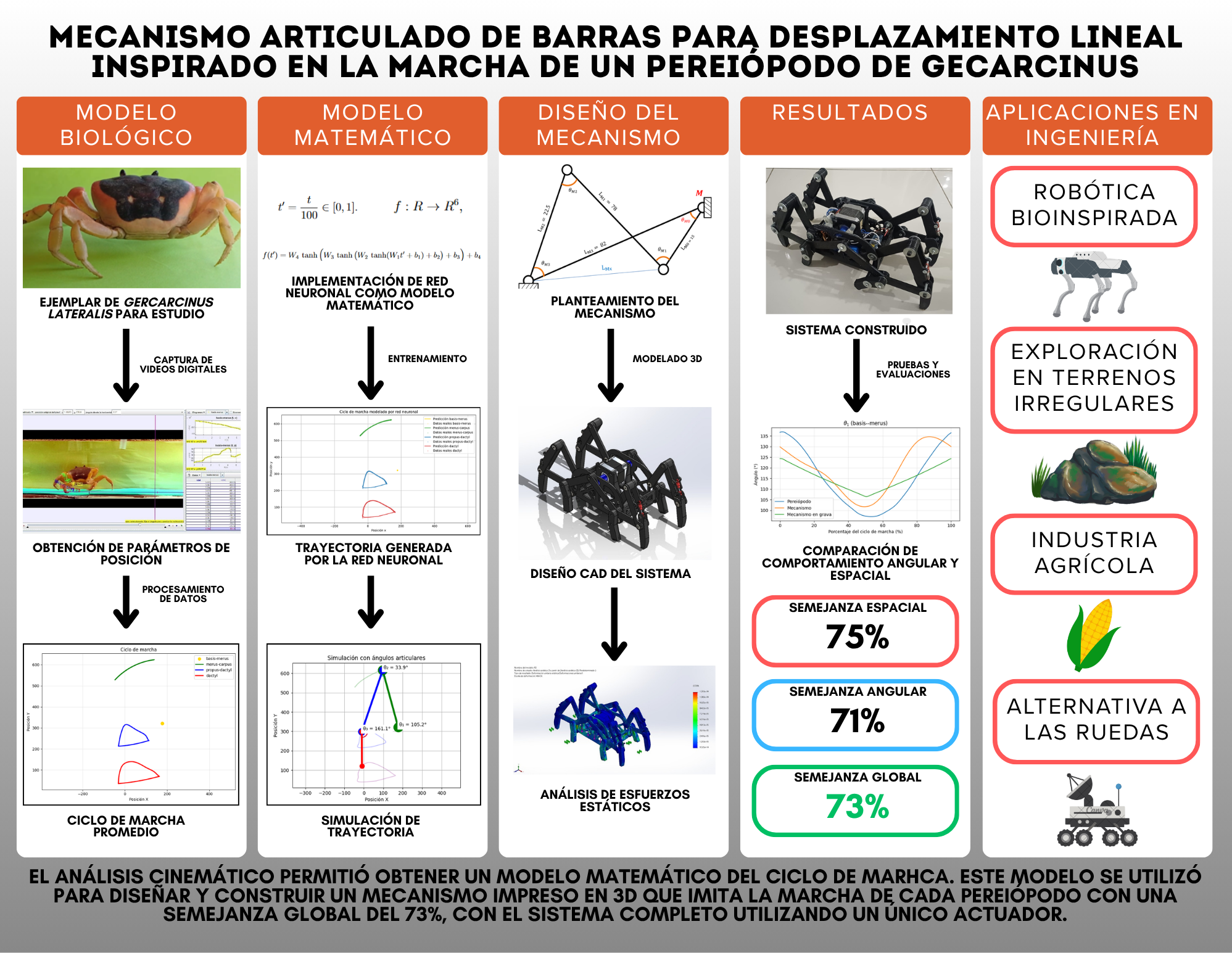
En este trabajo se analiza cinemáticamente el pereiópodo del cangrejo terrestre Gecarcinus lateralis para obtener los parámetros que describen su marcha. A partir de estos datos se construye un modelo matemático del ciclo de marcha promedio mediante una red neuronal multicapa, el cual se emplea para el diseño y construcción de un mecanismo de barras tipo Klann capaz de imitar su desplazamiento lineal. Finalmente, se compara el comportamiento del sistema mecánico con el del organismo biológico mediante métricas espaciales y angulares. Los resultados muestran una semejanza global del 73 % y del 65 % en condiciones de terreno irregular.
##plugins.generic.usageStats.downloads##
##plugins.generic.usageStats.noStats##
Article Details
Como citar
CASTRO DAZA, Guillermo; ANZUETO RÍOS, Álvaro.
Mecanismo Articulado de Barras para Desplazamiento Lineal Inspirado en la Marcha de un Pereiópodo de Gecarcinus.
Ideas en Ciencias de la Ingeniería, [S.l.], v. 4, n. 3, p. 26-47, nov. 2026.
ISSN 2992-7447.
Disponible en: <https://ideasencienciasingenieria.uaemex.mx/article/view/28368>. Fecha de acceso: 01 nov. 2026
doi: https://doi.org/10.36677/rici.v4i3.28368.
Sección
Artículos

Esta obra está bajo licencia internacional Creative Commons Reconocimiento-NoComercial-SinObrasDerivadas 4.0.
Citas
[1] J. K. Sheba, R. E. Mohan, E. Martínez-García, and L. Tan-Phuc, “Trajectory generation and stability analysis for reconfigurable klann mechanism based walking robot,” Robotics, vol. 5, p. 13, 2016. DOI: 10.3390/robotics5030013
[2] C. A. Hui, “Walking of the shore crab pachygrapsus crassipes in its two natural environments,” The Journal of Experimental Biology, vol. 165, pp. 213–227, 1992.
[3] M. M. Martinez, R. Full, and M. Koehl, “Underwater punting by an intertidal crab: a novel gait revealed by the kinematics of pedestrian locomotion in air versus water,” The Journal of experimental biology, vol. 201 (Pt 18), pp. 2609–23, 1998.
[4] C. F. Herreid and R. Full, “Locomotion of hermit crabs (coenobita compressus) on beach and treadmill,” The Journal of Experimental Biology, vol. 120, pp. 283–296, 1986.
[5] X. Chen et al., “Prototype development and gait planning of biologically inspired multi-legged crab-like robot,” Mechatronics, vol. 23, no. 4, pp. 429–444, 2013.
[6] C. Cui et al., “Kinematic analysis and simulation of walking leg of bionic amphibious crab-like robot,” in IEEE International Conference on Control, Automation and Robotics, 2020, pp. 762–767.
[7] S. Hu et al., “Leg mechanism design and motion performance analysis for an amphibious crab-like robot, ”Journal of Marine Science and Engineering, vol. 12, no. 1, p. 10, 2023. DOI: 10.3390/jmse12010010
[8] J. Zhang et al., “Crab-inspired compliant leg design method for adaptive locomotion of a multi-legged robot, ”Bioinspiration & Biomimetics, vol. 17, no. 2, p. 025001, 2022. DOI: 10.1088/1748-3190/ac45e6
[9] Y. Chen et al., “Optimal planar leg geometry in robots and crabs for idealized rocky terrain,”Bioinspiration & Biomimetics, vol. 17, no. 6, p. 066009, 2022.
[10] ——, “Sideways crab-walking is faster and more efficient than forward walking for a hexapod robot, ”Bioinspiration & Biomimetics, vol. 17, no. 4, p. 046001, 2022. DOI: 10.1088/1748-3190/ac6847 pág. 17 IDEAS EN CIENCIAS DE LA INGENIERÍA VOL. 2, NÚM. 1 enero-junio 2024 " " ISSN: 2992-7447 págs. 1- 1
[11] J. S. Toquica, P. S. Oliveira, W. S. R. Souza, J. M. Motta, and D. Borges, “An analytical and a deep learning model for solving the inverse kinematic problem of an industrial parallel robot,” Comput. Ind. Eng., vol. 151, p. 106682, 2020. DOI: 10.1016/j.cie.2020.106682
[12] A. G. Vidal-Gadea and J. H. Belanger, “Muscular anatomy of the legs of the forward walking crab Libinia emarginata,” Arthropod Structure & Development, vol. 38, no. 3, pp. 179–194, 2009. DOI: 10.1016/j.asd.2008.12.002